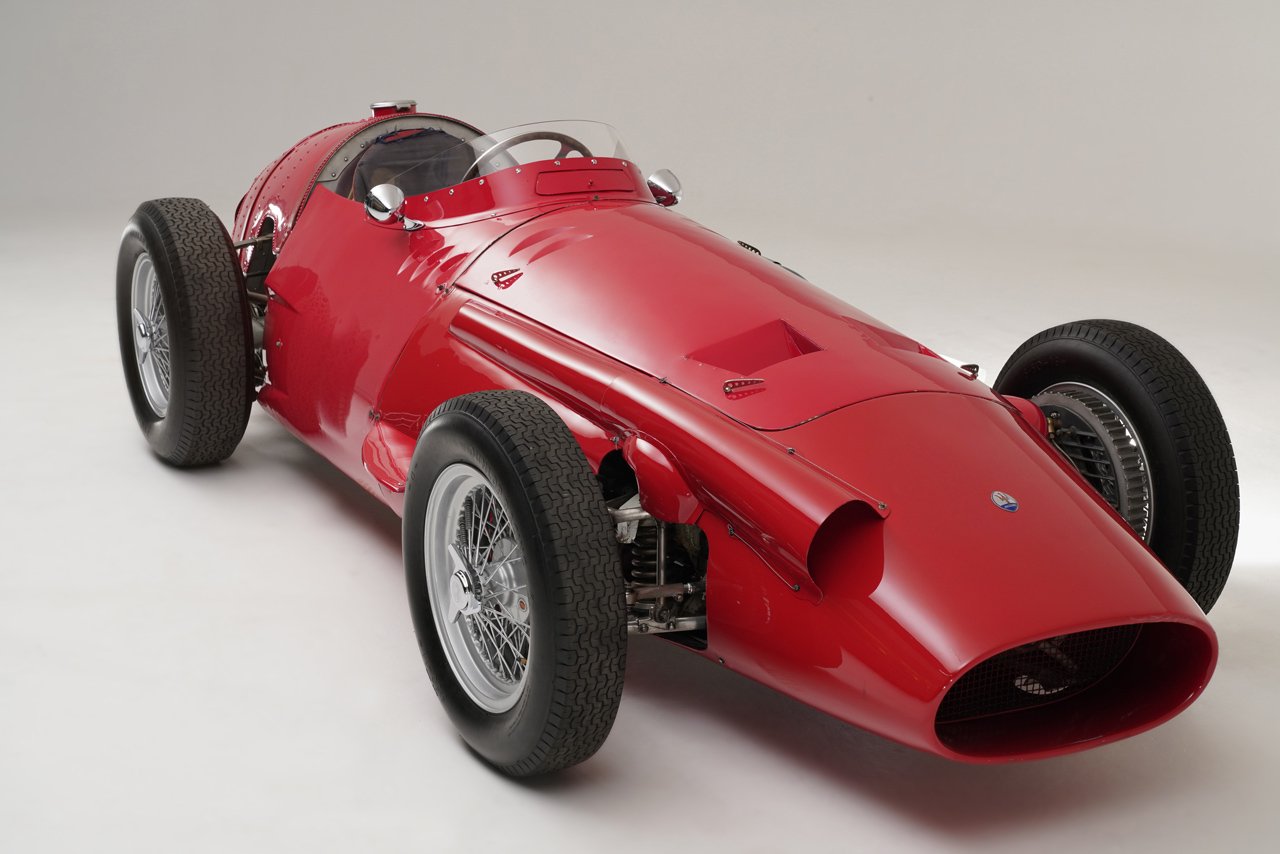
1952 Maserati 250F - A6GCM/250F ‘Interim’
1952 · Geneva, Zwitserland · via Classic Driver
Bekijk op Classic Driver → Open in de app

Gegevens
| Merk | Maserati |
|---|---|
| Model | 250F A6GCM/250F ‘Interim’ |
| Bouwjaar | 1952 |
| Transmissie | Handgeschakeld |
| Brandstof | Benzine |
| Kleur | Red |
| Locatie | Geneva, Zwitserland |
| Verkoper | Kidston Motor Cars (handelaar) |
| Bron | Classic Driver |
| Chassisnummer | 2518 |
| engine_number | 2518 |
| Staat | Original Condition |
| Op Oudjes.xyz sinds | 5 oktober 2026 |
| Laatst gezien | 5 oktober 2026, 18:19 |
Beschrijving
Ex-Juan Manuel Fangio, ‘Toulo’ de Graffenried, Ottorino Volonterio, Erwin Sommerhalder
1952-1956 Maserati A6GCM/250F ‘Interim’
Chassis no. 2518* Engine no. 2518
• First raced as an A6GCM by the Maserati factory at Monza, 8 June 1952: Juan Manuel Fangio, retired, accident
• Driven in Formula 2 and Grand Prix races throughout 1953 by top-level Swiss privateer Baron Emmanuel ‘Toulo’ de Graffenried, including wins at Goodwood, the Syracuse GP and the Eifelrennen
• Updated to Formula 1 250F ‘Interim’ specification for de Graffenried for 1954 (Argentine, Belgium and Spanish Grands Prix), then sold to Swiss-Italian amateur Ottorino Volonterio
• Camera car ‘Burano’ during 1954 for the 1955 motion picture The Racers starring Kirk Douglas
• Only three owners since late 1956, the current one for 26 years, and fresh to the market
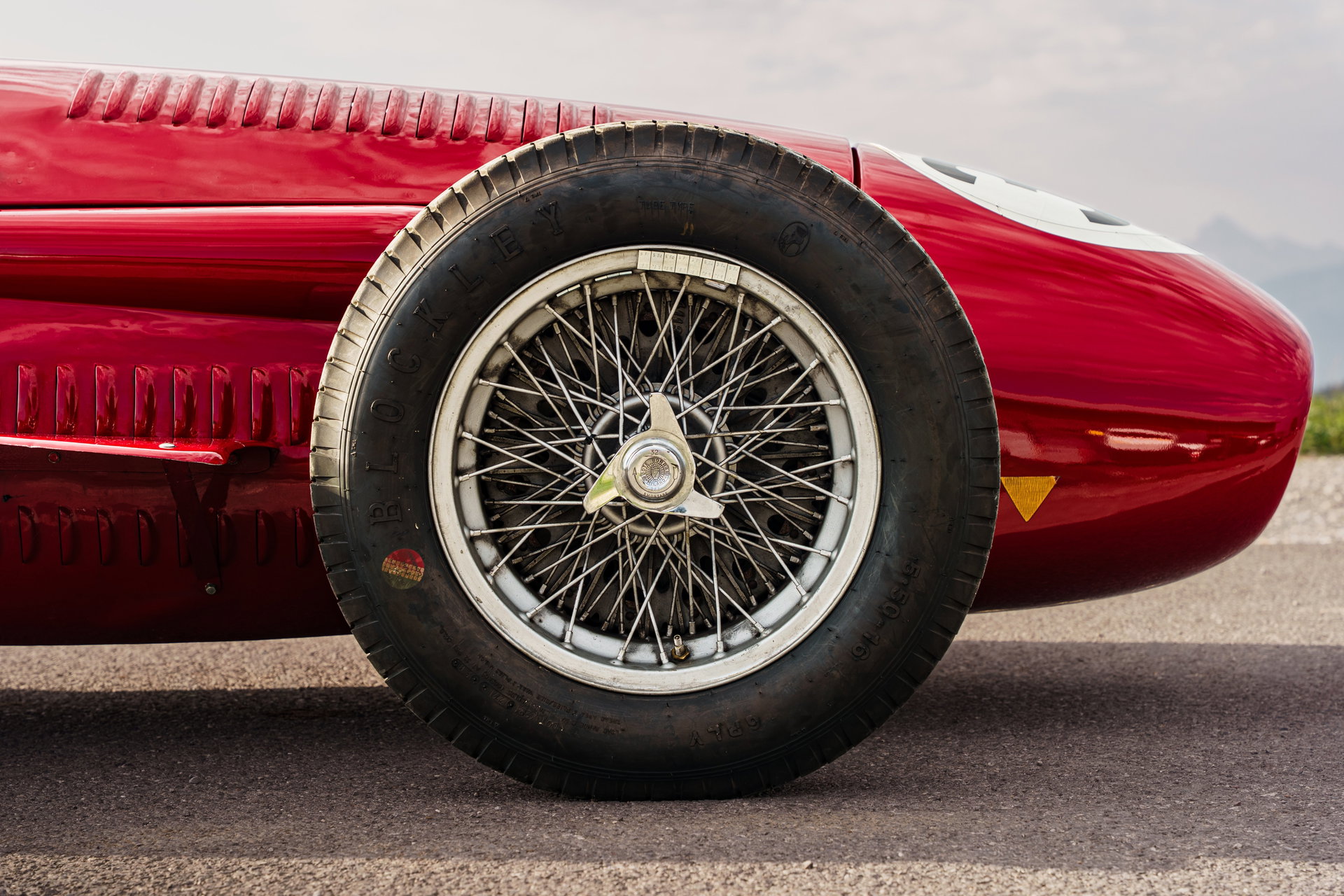
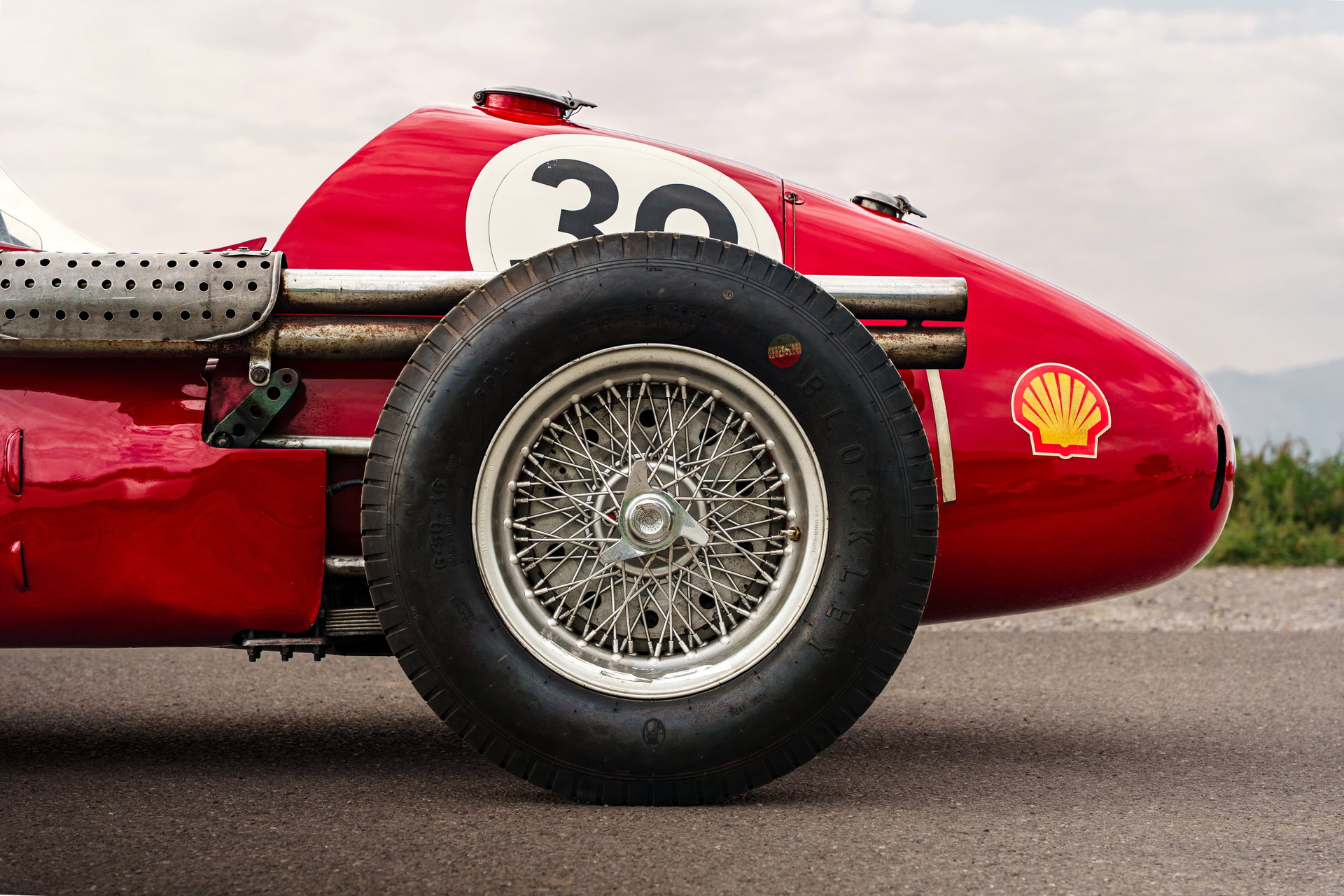
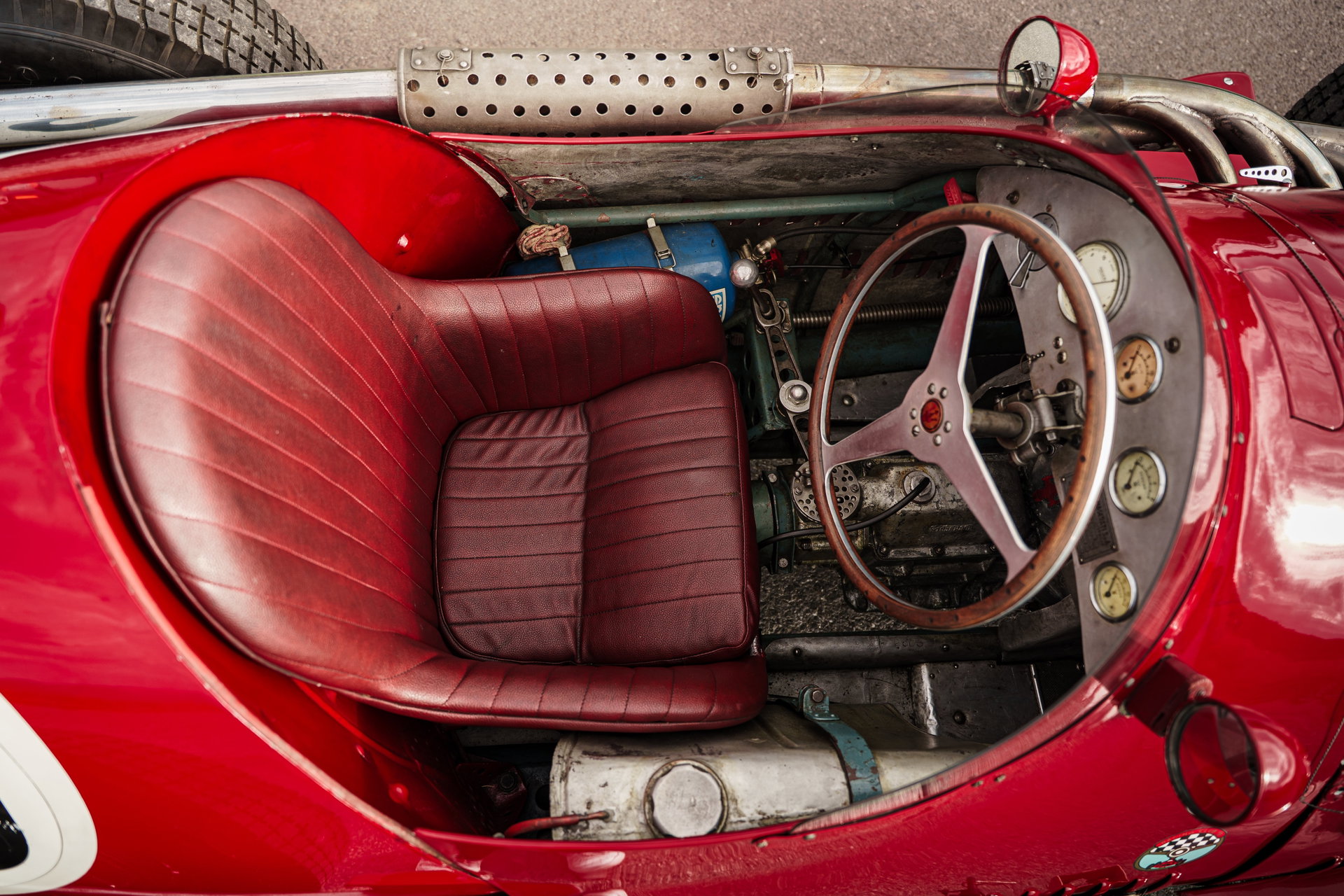
• A genuine 1950s Maserati 250F Formula 1 racing car with continuous history eligible for world class historic events, including the Goodwood Revival and Grand Prix de Monaco Historique
• European status
* chassis no. 2038 as an A6CGM 1952-1953, chassis no. 2510 as a 250F 1954-1955, chassis no. 2518 as a 250F 1956 onwards
“Under the anxious eyes of the Orsis and their senior designers, Bertocchi took the 250F out on the Modena track. When he returned after its baptismal laps, the burly veteran prolonged the suspense. Climbing out, he pulled off his skullcap and goggles and tucked them neatly away with his gloves. Finally Adolfo Orsi [Snr.] broke the pregnant silence: “Guerino, what?”
““Gentlemen,” Bertocchi replied, “at last we have an automobile deserving of the name.””
Karl Ludvigsen, in his 2008 title ‘Red-Hot Rivals’, describes the moment when Maserati under the ownership of the Orsi family realised they had a winner with the new 250F on a wintry day just after Christmas 1953.
The 250F went on to great successes throughout the 1950s, constantly developed to give driving heroes such as Stirling Moss, Jean Behra, Luigi Musso and Juan Manuel Fangio countless wins and places in Championship and non-Championship Formula 1 races across the globe. The great Argentine won the 1954 World Championship driving a 250F when a Mercedes-Benz W196 was not available, triumphing again in 1957 – perhaps at the peak of his powers – in a works 250F.
Orders for the 250F came in faster than Maserati could build them; 1954 was the start of the new 2.5-litre Formula 1 rules.
As a result, to meet demand and have racing cars on the grid for the new season, several older A6GCM single-seaters were adapted to carry the latest engine. Uprated cars were sold to established drivers including ‘B. Bira’, Harry Schell, Roberto Mieres and Baron Emmanuel ‘Toulo’ de Graffenried, who had his own car adapted for the bigger powerplant. All are now known retrospectively as ‘Interims’.
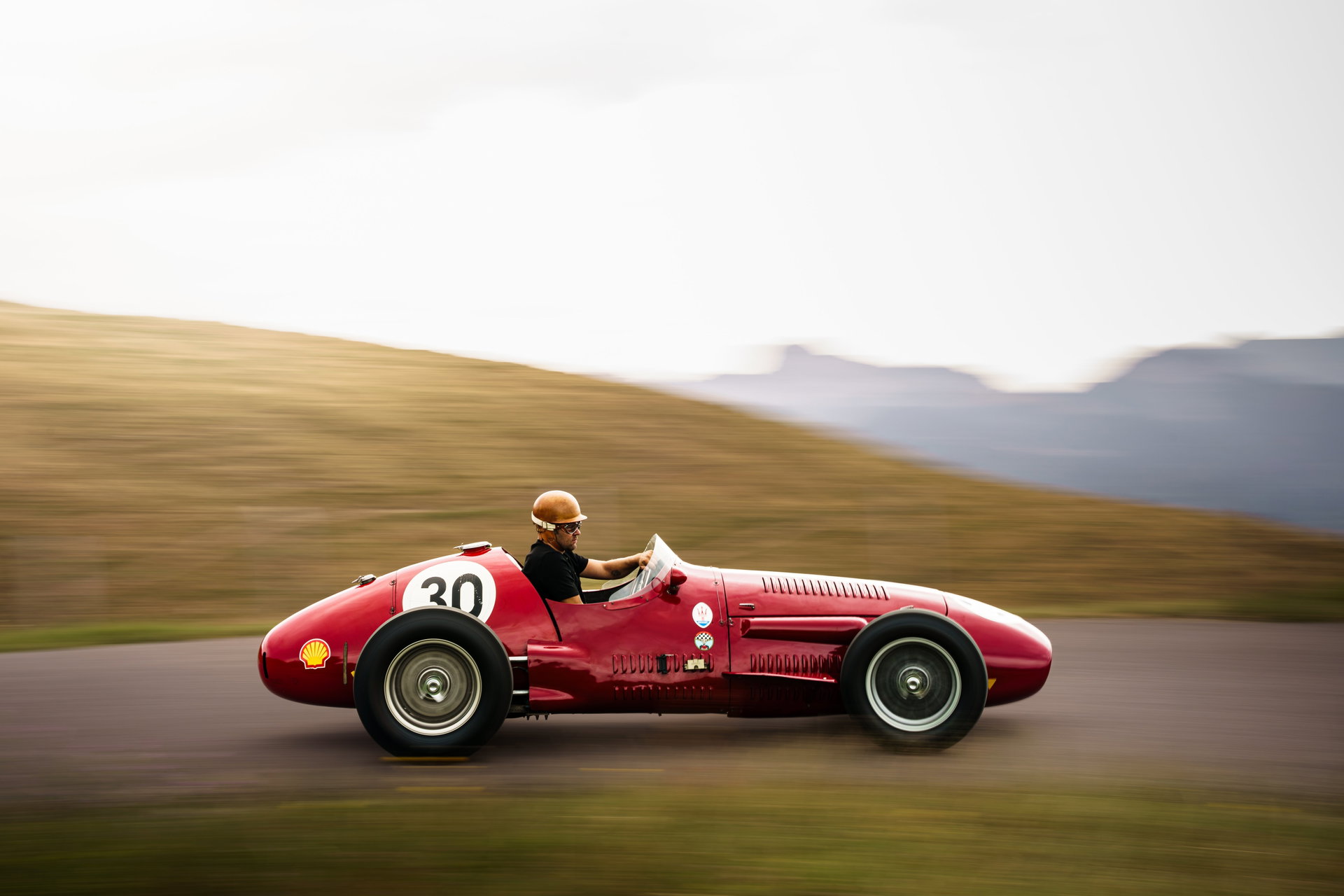
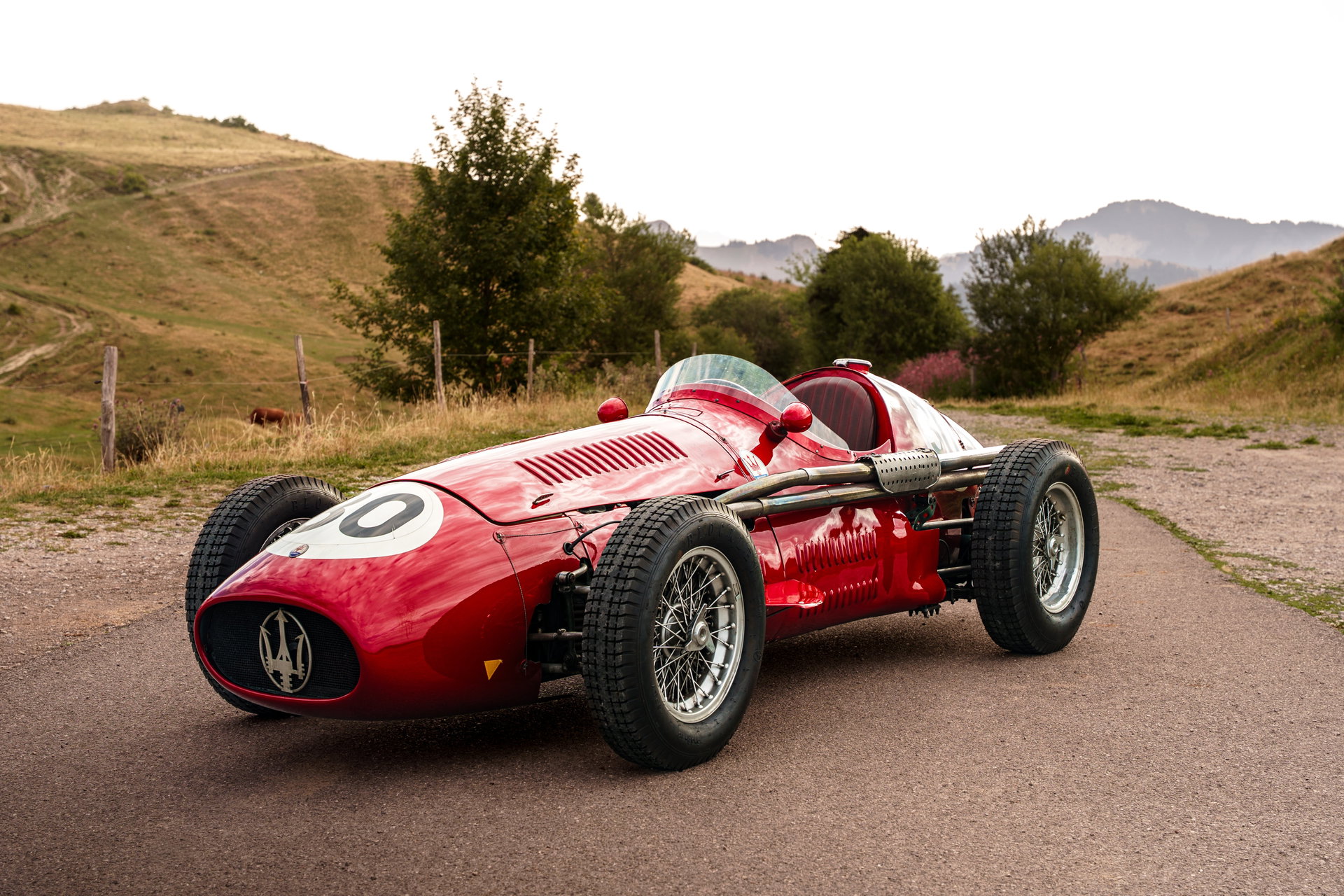
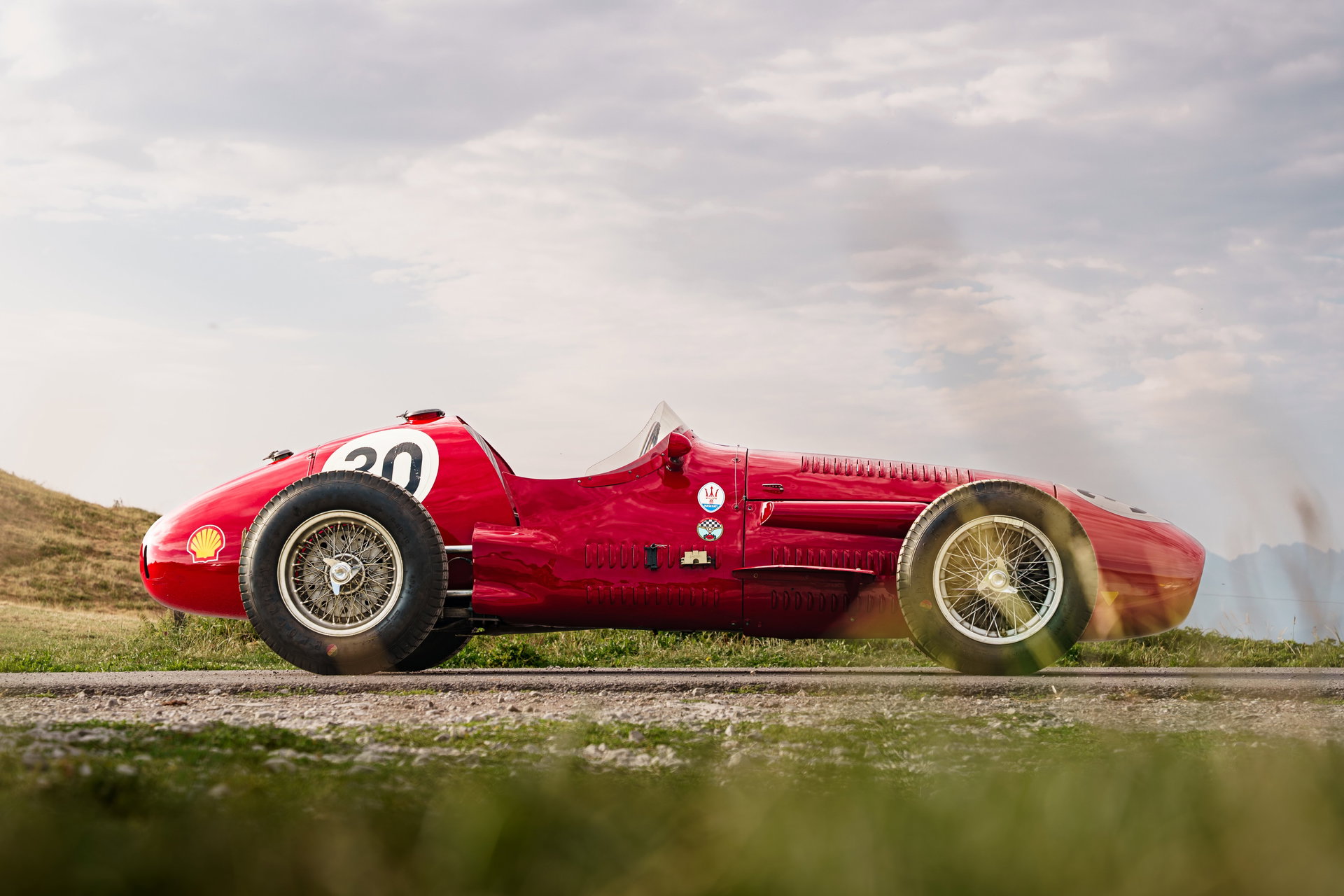
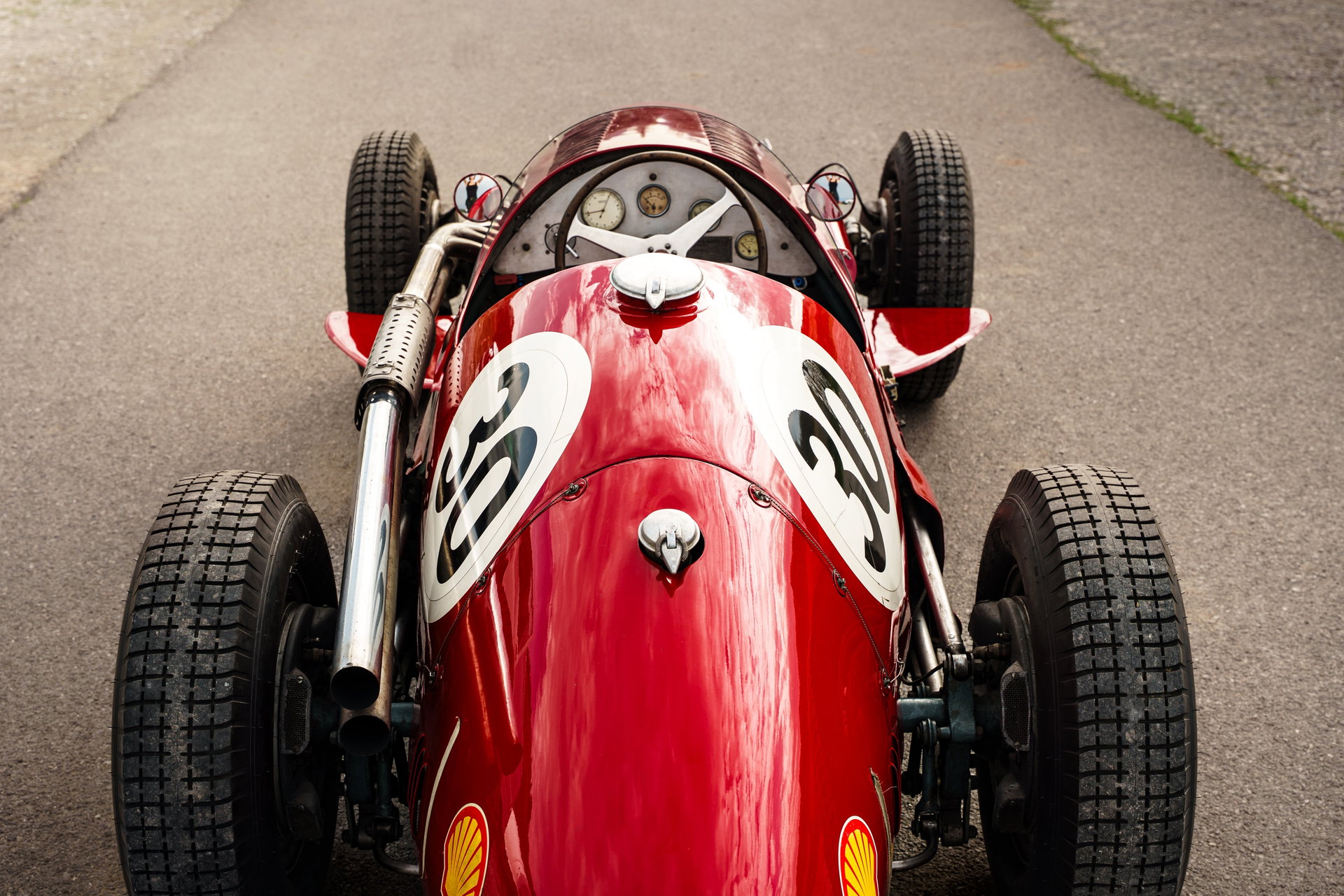
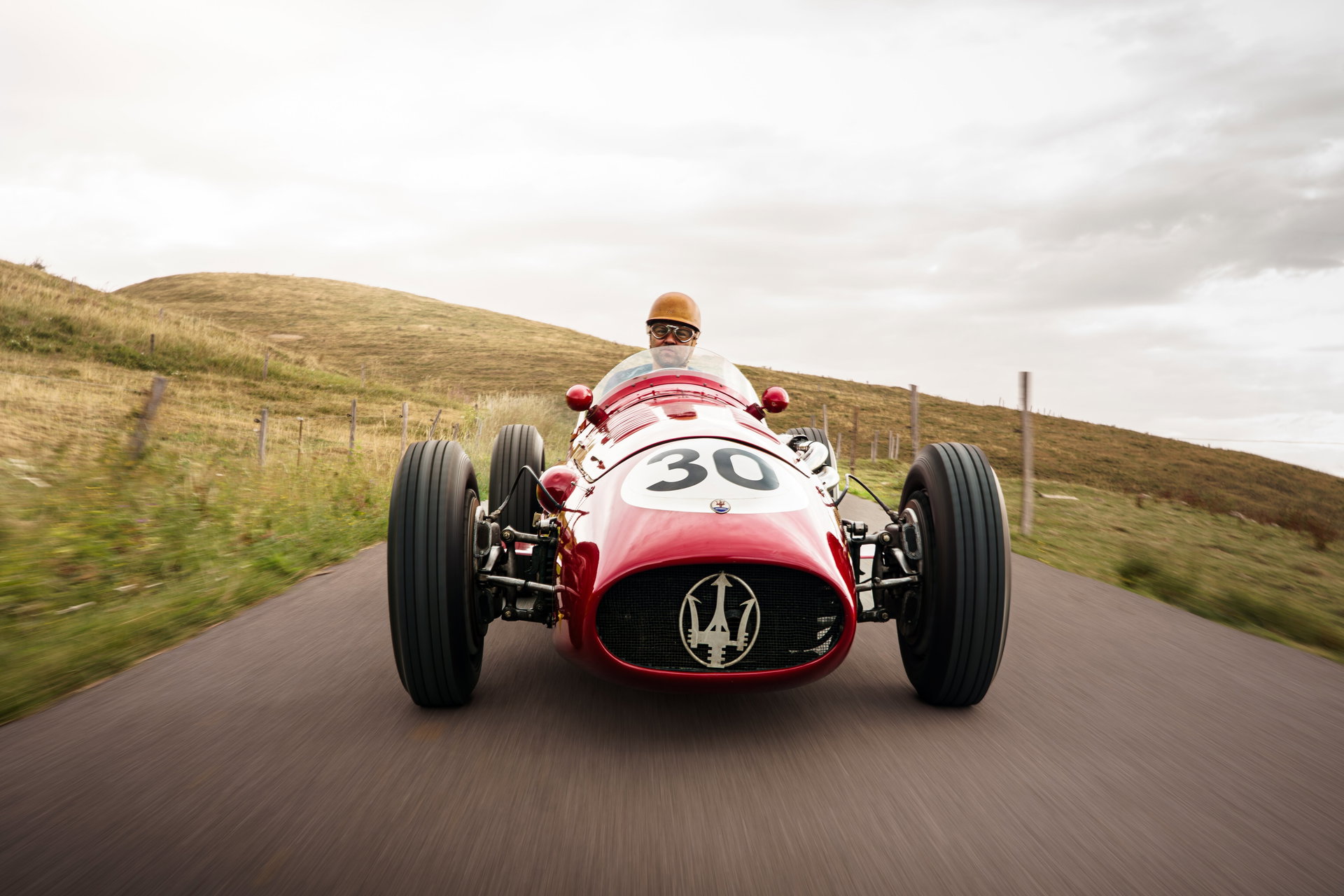
This is ‘Toulo’ de Graffenried’s Maserati 250F ‘Interim’.
The Maserati 250F ‘Interim’
From 1952 to 1953, the F1 World Championship was fought with 2.0-litre Formula 2 machinery, though contestants knew well in advance that in 1954 new rules would introduce larger, 2.5-litre engines.
The races were closely contested by Ferrari with its four-cylinder 500 F2 and Maserati, who developed a modern single-seater powered by a twin-cam version of the A6GCS sports car’s straight-six. The resulting A6GCM (‘M’ for ‘Monoposto’ or single-seat) was a typical tubular-chassis racing car of the day with longitudinal members braced by a framework of smaller tubes.
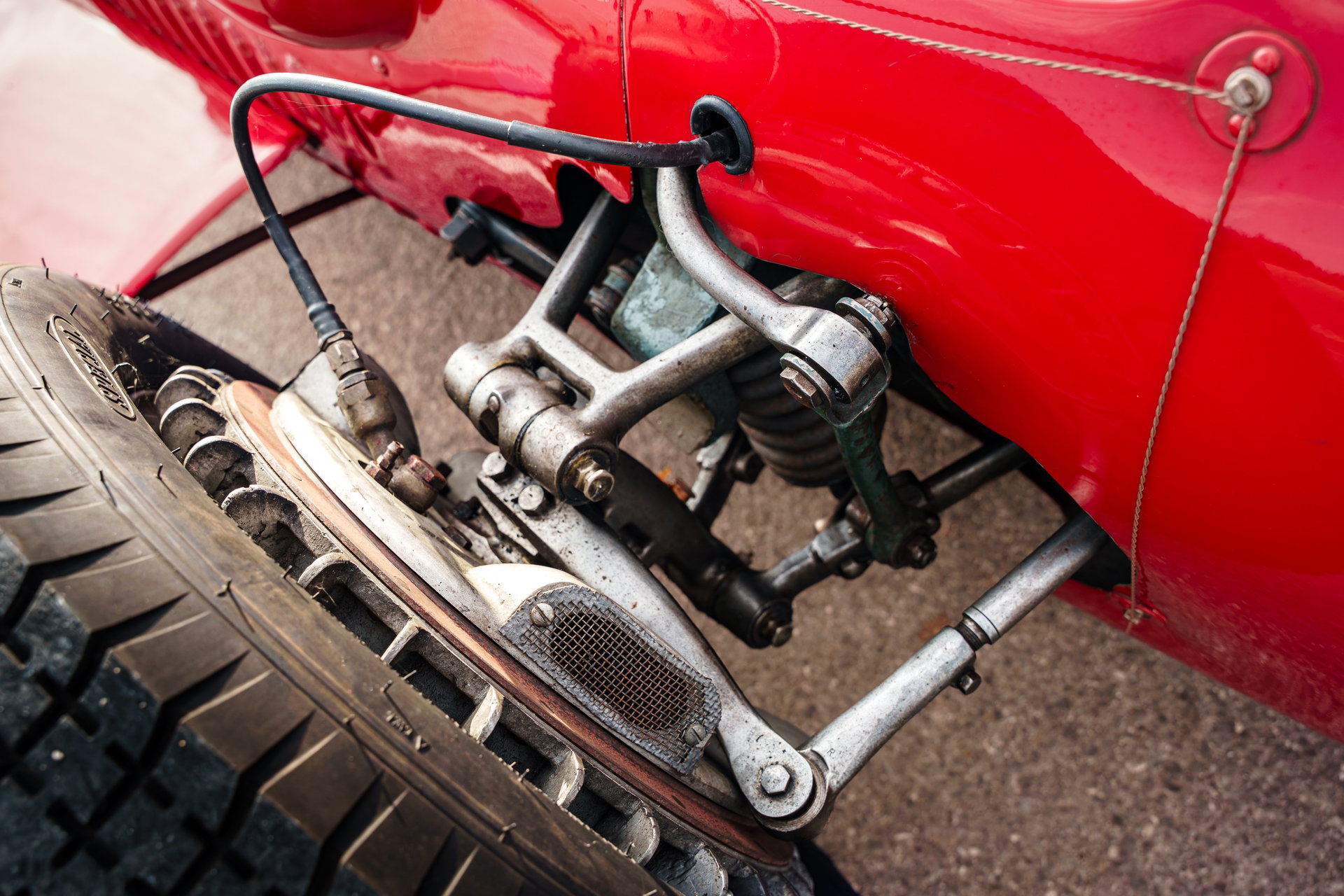
Engineer Alberto Massimino worked on the twin-cam engine from the A6GCS, shortening the stroke and widening the bore to increase the rev range of the 1,960cc unit to 6,500rpm, at which point power was 160bhp when running on alcohol fuel. Ferrari’s 500 F2 revved to a heady 7,800rpm, producing 165bhp at 7,000rpm. The A6GCM’s four-speed gearbox was in unit with the engine; the axle ‘live’, sprung by leaf springs; front suspension was coil springs; hydraulic dampers were fitted all round; braking was via big drums.
For 1953, the cars were gradually updated with twin-plug engines first seen towards the end of 1952, now producing up to 197bhp; revised, more streamlined and modern-looking bodies by Fantuzzi and rear suspension further developed to reduce the height of the driver’s seat.
Design of Maserati’s challenger for the new Formula 1 rules was initiated by Gioacchino Colombo, who had joined the Trident from Alfa Romeo in late 1952 and was responsible for the heavily revised 1953 A6GCM before leaving in October that year. The new 250F, therefore, was a mix of input from Colombo – the man behind Ferrari’s famous V12 – and Maserati engineers Vittorio Bellantini and Valerio Colotti, a new recruit from Ferrari.
It was an all-new car with a small-diameter-tubing space-frame chassis, a 2,493cc ’six that bore no relation to the previous one and a new set-up by Colotti at the rear featuring a gearbox in unit with the final drive, a single transverse leaf spring and de Dion tube.
The engine featured twin spark plugs, double overhead camshafts and ‘oversquare’ dimensions of 84mm x 75mm. Running on a mixture of methanol and benzol, it developed 240bhp at 7,400rpm. The ‘250/F1’, later to be known as simply ‘250F’, was a good design; constantly improved, it remained competitive throughout the 1950s until the British ‘rear-engined revolution’ took all before it in 1959.
As we have seen, demand for the car outstripped supply and such was the pressure on the factory to field a team of cars in the January 1954 Argentine Grand Prix, five 1953-spec A6GCMs – ‘Interim’ cars – were prepared for Grand Prix racing in 1954 with the brand-new engine of the 250F attached directly to the gearbox.
The late, great guru Denis Jenkinson proposed the following chassis as 250F ‘Interims’ (all renumbered from their A6GCM days):
‘2501’ for Roberto Mieres.
‘2502’ spare factory car at the Argentine GP, then to Argentine driver Jorge Daponte.
‘2503’ for Harry Schell.
‘2504’ for ‘B. Bira’.
‘2510’ for ‘Toulo’ von Graffenried.
This Motor Car
Like almost all 250Fs, this car was rebuilt – perhaps better described as ‘reconfigured’ – by the factory on more than one occasion in its life, and was issued with three chassis numbers by the Works.
It was born in 1952 as chassis no. 2038, a brand-new factory A6GCM for Juan Manuel Fangio. The 1951 World Champion was set to drive one of the new works cars at the 18 May Swiss Grand Prix at Berne, but Maserati failed to turn up. So the first event for him and A6GCM ‘2038’ was the 8 June non-Championship Monza Grand Prix, a highly anticipated showdown on local soil between five works Maseratis and five cars from Scuderia Ferrari.
Fangio had been racing a BRM in Dundrod, Northern Ireland the day before. He was only able to obtain last-minute flights to Paris, so drove through the night from the French capital to Monza, arriving at the circuit on the day of the race. Despite no practice time, by virtue of his standing he was granted last place on the grid. But his race was short-lived; in his own words:
“On the second lap I was looking to overtake as many cars as I could, for I knew the Monza track well. In the Lesmo curve I touched the edge with the car, I let the car slide out a bit more than was prudent, and the last straw bale was suddenly underneath my car. They had been there for more than three years and were rock hard… When I woke up I was in hospital. I didn’t even have time for fear.”
The car was badly damaged; Fangio had been thrown clear but was unconscious for many days and broke a bone in his spine. He did not race again that year and the crash was probably the reason Ascari and Ferrari won the World Championship.
Maserati rebuilt it, and it was ready for aristocratic privateer Emmanuel ‘Toulo’ de Graffenried to use the following year. The Swiss baron had started racing a Maserati voiturette in 1936, was an occasional works Alfa Romeo driver in the early 1950s and clearly a very good customer of the Trident. De Graffenried and his A6GCM ‘2038’ ran in the following Formula 2 races in 1953, though Milan-based (but Argentine-born) Enrico Platé often ran Maseratis for busy and wealthy privateers such as de Graffenried, and the baron’s race entries are occasionally shown as ‘Maserati-Platé’:
22 March Syracuse Grand Prix, 1st.
6 April Goodwood Lavant Cup, 1st. Chichester Cup, 1st. Glover Trophy, 3rd.
3 May Bordeaux Grand Prix (non-Championship), retired (rear axle).
9 May Daily Express International Trophy Silverstone, 1st (with 180bhp engine).
16 May Ulster Trophy Dundrod, retired (rear axle).
31 May Eifelrennen Nürburgring, 1st.
7 June Grand Prix of the Netherlands Zandvoort, 5th.
21 June Belgian Grand Prix Spa, 4th.
5 July French Grand Prix Reims, 7th.
12 July 3rd International Hill Climb Race Vue des Alpes, result unknown.
18 July British Grand Prix Silverstone, retired (clutch/plugs).
26 July Circuit de Lac Aix-les-Bains, retired (ignition)
2 August German Grand Prix Nürburgring, 5th.
23 August Swiss Grand Prix Bremgarten, retired (transmission).
30 August 5th Grand Prix de Cadours (non-Championship), retired.
13 September Italian Grand Prix Monza, retired (engine).
20 September Modena Grand Prix, 3rd.
From at least the 7 June Dutch Grand Prix onwards the car is seen with the latest Fantuzzi bodywork, and by the 18 July British Grand Prix it has a white bonnet.
The results, considering opposition in the form of Ascari, Hawthorn, Moss and Fangio are extraordinary, though almost non-stop racing throughout the season clearly took a toll on the car.
For the new Formula 1 championship starting in 1954 the car was rebuilt and modified to ‘Interim’ specification with a fresh 250F engine. As this was a significant change the factory renumbered the car ‘2510’, carrying that identification until 1956. De Graffenried entered three World Championship Grands Prix in the car before gradually stepping away from single-seater racing, preferring Maserati and Ferrari sports cars. In 1956, at the age of 42, he was hired by Mimmo Dei to drive the Scuderia Centro-Sud Maserati 250F, qualifying 18th and finishing 7th at the Italian Grand Prix. His 1954 entries with newly renumbered ‘2510’ were:
17 January Argentine Grand Prix, 8th.
18 April Easter Bank Holiday Meeting Goodwood, entered but did not start.
20 June Belgian Grand Prix Spa, used only as a film car ‘Burano’ for The Racers
26 October Spanish Grand Prix, 21st, sharing with Ottorino Volonterio.
In summer 1954 the car was employed as both a camera car and, slightly disguised, with another Maserati A6GCM as a ‘Burano’ in the Henry Hathaway CinemaScope motion picture The Racers (alternative, Such Men are Dangerous) starring Kirk Douglas, Bella Darvi and Lee J. Cobb. De Graffenried drove ‘2510’ with a camera attached to the nose at the 1954 Belgian Grand Prix and in many scenes served as Douglas’s driving double. The film was released on 4 February 1955.
Swiss-Italian driver Count Ottorino Volonterio, who had driven de Graffenried’s old 4CLT Maserati and shared ‘2510’ with its owner at the 1954 Spanish Grand Prix, bought the car in late 1954. He entered the following events:
1955
8 May Naples Grand Prix, 7th.
13 August West Essex Club’s International Snetterton, 11th.
23 October Syracuse Grand Prix, retired (transmission)
1956
6 May Naples Grand Prix, 5th.
14 July British Grand Prix Silverstone, entered but did not start.
5 August German Grand Prix Nürburgring, disqualified (failed to cover required percentage of the winner’s distance).
Compared with the talented and determined de Graffenried, who won many Grands Prix against the best drivers in the world, Volonterio was simply there to enjoy himself at his own leisurely pace. The car was returned to Maserati at the close of 1956 and fitted with a fresh engine from 250F chassis no. 2518, Jean Behra’s streamliner destroyed by fire at the Maserati factory. As a result, this car was renumbered to match the new engine: ‘2510’ became ‘2518’, the chassis plate it bears today.
Swiss hillclimb specialist Erwin Sommerhalder purchased it in November 1956, campaigning it in national events from 1957 to 1962. In 1966 he sold it to pioneering Swiss collector Walter Grell, whose museum in Rheinfelden near Basle on the border with Germany was noted for its broad range of exhibits that included the significant Maserati, a Cadillac V-16, Cooper-Maserati V12, Vignale-bodied OSCA, 1970 March 702 and BRM P578 Formula 1 car. The collection was disposed of at auction in 2000 where our client bought ‘2518’.
Since purchase, the A6GCM/250F ‘Interim’ has been prepared for historic racing and campaigned enthusiastically in all the best events, including around ten seasons in the now-defunct Ferrari Maserati Historic Challenge, the Grand Prix de Monaco Historique on several occasions, the Goodwood Revival, the Montreux Grand Prix and many others. When racing, the 250F ‘Interim’ has been looked after by experienced Italian Maserati mechanic Gianni Torelli and many of his invoices accompany the car.
Unlike so many other 250Fs, this one’s history is well-known. And what a history: given its race debut by the great Juan Manuel Fangio; a Grand Prix winner first time out with its privateer owner Baron ‘Toulo’ de Graffenried; one of the first ‘Interims’ to use Maserati’s all-new, state-of-the-art racing engine for 1954; and the star of the silver screen in action in The Racers. Extensive periods in single ownership – just three from late 1956 – have maintained its originality, avoiding modern historic racing practice and the current ‘modify to win at all costs’ philosophy.
For those seeking a thoroughbred F1 monoposto granting access to the world’s most exclusive events, with a glamorous history and bearing one of the most prestigious marque emblems in motor racing history, this is your car.
Vergelijkbare oudjes
 1954 Maserati 250FPrijs op aanvraag1954 · Verenigd Koninkrijk · Classic Driver
 1955 Maserati 250FPrijs op aanvraag1955 · Duitsland · Classic Driver
Wat doet een Maserati 250F op de markt? Bekijk de marktwaarde →